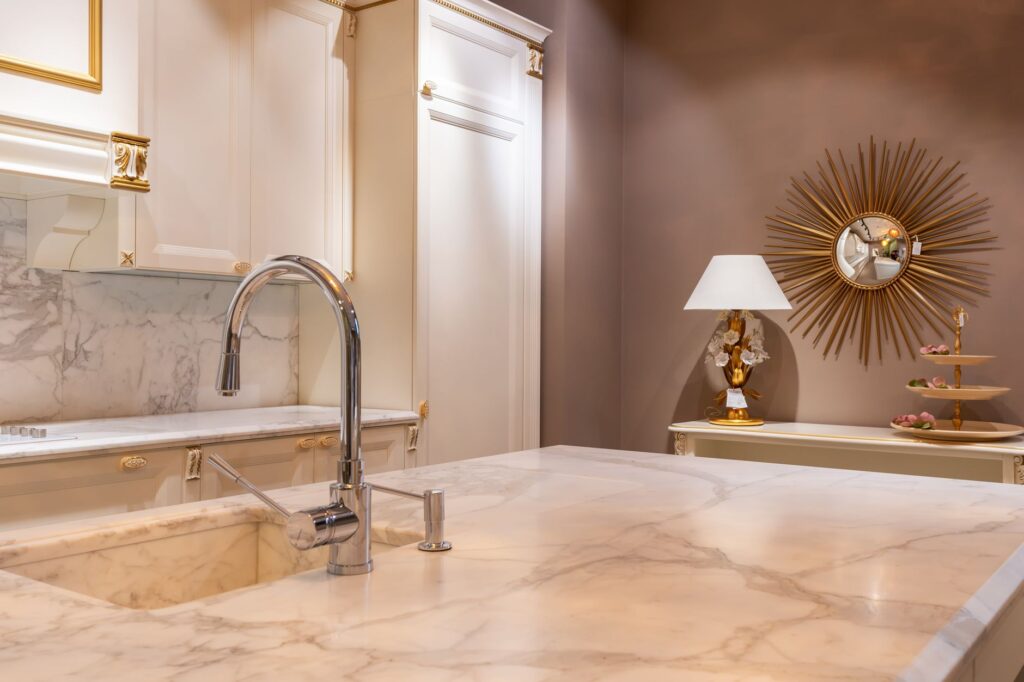
Marble worktops are cut from a natural stone prized for its veining and its cool, polished look. They suit UK kitchens where appearance matters most and the owner accepts some upkeep. They are less practical for a busy family kitchen, because marble marks more easily than granite or quartz. This guide explains what marble worktops are like to live with, so you can weigh the looks against the care.
What marble is
Marble is a metamorphic rock. It forms when limestone or dolomite recrystallises under heat and pressure over long periods. Most marble is made mainly of carbonate minerals, usually calcite or dolomite. The Wikipedia entry on marble sets out these basics. Because it is a natural material, every slab has its own pattern, so no two worktops look exactly alike.
Fabricators cut marble from polished slabs and shape the edges to suit the design. Some suppliers also offer engineered marble, which is a manufactured product. It behaves differently from natural stone, so check exactly what you are buying.
Looks and finishes
Marble is valued for its veining, the flowing lines of colour that run through the stone. Popular choices include white and cream bases with grey or gold veins. Some marbles are nearly plain, while others are heavily patterned. Darker varieties exist too, though they are less common in kitchens.
The finish changes both the look and the wear. A polished finish gives a glossy, reflective surface that shows the veining well. A honed or matt finish is softer and hides some marks, but it can look less dramatic. Ask your fabricator to show full-size samples in your kitchen light, because a small sample can look quite different across a long run.
Durability: heat, scratches, stains and water
Marble is softer than granite or quartz, so knives, grit and heavy pans can leave marks. Light scratches can sometimes be polished out, while deeper ones usually need a professional. Chopping on a board rather than on the stone itself is a simple habit that makes a real difference.
Marble copes with normal cooking heat, but a very hot pan set straight on the surface can still cause problems. Sudden temperature changes can also crack the stone. Trivets and mats are a sensible habit for hot cookware.
Stains are the main concern. Marble is porous, so liquids can soak in and leave marks, especially oil, wine, tea and coffee. Acidic liquids such as lemon juice and vinegar can etch the surface and leave dull patches. Water does little harm if you wipe it up, but standing water around taps and sinks can stain the stone over time.
Hygiene and care
Most marble worktops benefit from a sealer applied after fitting and repeated at intervals. A sealer slows staining, but it does not make the stone stain-proof. Recommended products and intervals vary, so follow the sealer maker’s instructions and your fabricator’s advice.
Wipe up spills promptly, and clean the surface with warm water and a mild, pH-neutral stone cleaner. Avoid vinegar, lemon-based cleaners, bleach and abrasive scourers. These can dull or etch the polish, and the damage may not come out.
Fitting, weight and support
Marble is heavy, so the base units must be level and strong enough to carry it. Fitters usually template the worktop once the units are in place, then cut and fit the slab. Long runs may need a joint, and you should agree where it goes before fabrication starts.
Cut-outs for hobs and sinks need care, because thin sections and sharp internal corners can crack. Check that your fitter has experience with natural stone, and ask whether the price includes sealing. Also ask how the front edge and any overhang will be supported. The weight depends on the slab’s thickness and size, so get specific figures from the supplier.
Likely cost
Marble often sits at the premium end of worktop materials. Prices vary widely with the stone type, slab quality, thickness, edge profile and fabricator. Installation, sink and hob cut-outs, and sealing all add to the total. This guide does not give a price range, because prices differ too much by region and supplier to quote fairly. Get written quotes from several fabricators and compare like with like. For a wider picture, see our guide to kitchen worktop costs in the UK.
Pros and cons of marble worktops
- Pros: a distinctive, natural appearance, with no two slabs alike.
- Pros: a cool surface that many bakers find useful for pastry work.
- Cons: softer and more porous than granite or quartz, so it scratches, etches and stains more easily.
- Cons: needs sealing and regular, gentle cleaning.
- Cons: heavy, so the units and support must be right, and cost is usually high.
- Cons: repairs to damage are often visible.
Who marble worktops suit
Marble suits homeowners who want a striking, natural look and are happy to look after it. It works well in a kitchen used mainly for preparation, or on a baking area or island where the stone can be a feature. It is less suited to busy households with young children, frequent cooking with acidic ingredients, or anyone who expects a worktop to stay flawless with no effort.
If you want the look with less upkeep, granite or quartz may be more forgiving. For a lower-cost option, laminate is widely available. Whichever you choose, the right answer depends on how you cook, how much care you will give the surface, and what you can spend.