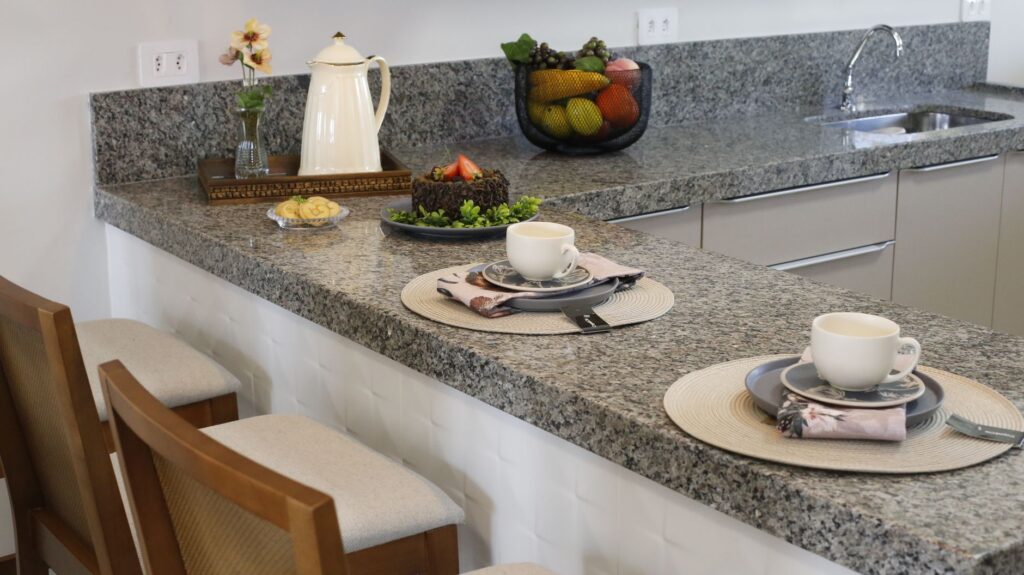
Granite worktops are cut from slabs of granite, a natural igneous rock. They are one of the most common choices in UK kitchens because they offer a hard, heat-tolerant surface and a wide range of colours. This guide covers what granite is like to live with, how it is fitted, what affects the cost and who it suits.
What granite worktops are and how they look
Granite forms when magma cools slowly underground. It is made mostly of quartz, feldspar and mica, and its mix of minerals gives each slab its own pattern of flecks and veining. The result is a natural stone with character, so no two slabs match exactly. Wikipedia’s entry on granite gives a good general background on the rock.
Colours run from pale creams and greys to deep blacks, reds and blues. The finish changes the look a great deal. A polished surface is glossy and brings out the colour. A honed surface is matt and softer to the touch, and it hides fine marks better than a polished one. Some suppliers also offer leathered finishes with more texture. Look at full-size samples in your own kitchen, because colour appears different under daylight and under LED lighting.
Durability: heat, scratches, stains and water
Granite is a hard stone and copes well with the wear of a busy kitchen. It is generally regarded as heat resistant, so a hot pan can usually stand on it without harm. Even so, it is sensible to use a trivet for dishes straight from the oven, because sudden temperature changes can crack any stone.
Scratches are less of a worry than with many materials. A heavy pan or a gritty pan base can still mark a polished surface, though. Chips are more likely at exposed corners and edges than across the middle of the work surface.
Stains depend mostly on sealing. Unsealed granite is porous and can take up oil, wine or coffee, which leaves a mark that is hard to lift. Many fabricators seal the stone when it is installed and suggest resealing at intervals. Practice varies, so ask your fitter what they recommend for the particular stone you buy. Once sealed, granite handles water well, but the joins and the area around the sink deserve a regular check.
Hygiene and everyday care
A sealed granite worktop is simple to keep clean. Wipe up spills promptly, then wash the surface with warm water and a mild washing-up liquid, and dry it. Avoid abrasive scourers, bleach-heavy cleaners and strong acidic products such as some limescale removers. These can dull the polish or damage the sealer.
Use a cutting board. Granite dulls knives quickly, and a board protects both the blade and the stone. A surface in good condition with an intact sealer is easier to keep hygienic than one that is worn or cracked, so check the sealer as part of routine care.
Fitting, weight and support
Granite is heavy, so the base units must be level, strong and fully supported before any stone arrives. Long runs may need support along the back or at the joins. Fitting usually takes place after the cabinets are in place. A fabricator takes a template, cuts the slab in a workshop, and then fits it on site with adhesive. Sink and hob cut-outs can be made in the workshop or on site, depending on the fabricator and the job. Because the work is heavy and precise, DIY fitting is rarely a good idea.
Likely cost
Prices vary widely. The total depends on the colour and rarity of the stone, the thickness, the finish, the length of the run, the edge profile, the sink and hob cut-outs, and the fitter’s rates in your area. We have not quoted figures because they change and differ between suppliers and regions. When you ask for quotes, check that each one covers the template, the stone, fitting, cut-outs, sealing and removal of your old worktop. Comparing like with like makes the differences clear. For a wider view of how the costs break down, see kitchen worktop costs in the UK.
Pros and cons of granite worktops
- Pro: a hard, heat-tolerant surface with a wide choice of colours and finishes.
- Pro: each slab is unique, which suits buyers who want a natural look.
- Pro: with routine care and sealing, it wears well in a busy kitchen.
- Con: it is heavy and needs strong, level base units and professional fitting.
- Con: it is porous until sealed, and the sealer needs checking from time to time.
- Con: it dulls knives and can chip at the edges.
- Con: prices vary, and the cost is not fixed.
Who granite worktops suit
Granite suits homeowners who want a natural stone surface, cook often and are happy to seal and check the surface now and then. It also suits people who like variation and character in a slab. It is less suitable for anyone who wants a uniform colour, has a tight budget, or plans to fit the worktop themselves.
If you want a more uniform look with less upkeep, quartz worktops are the usual alternative. Engineered quartz is generally less tolerant of direct heat than granite, so the two suit different habits. To compare the main options side by side, read our guide to the best kitchen worktop material.