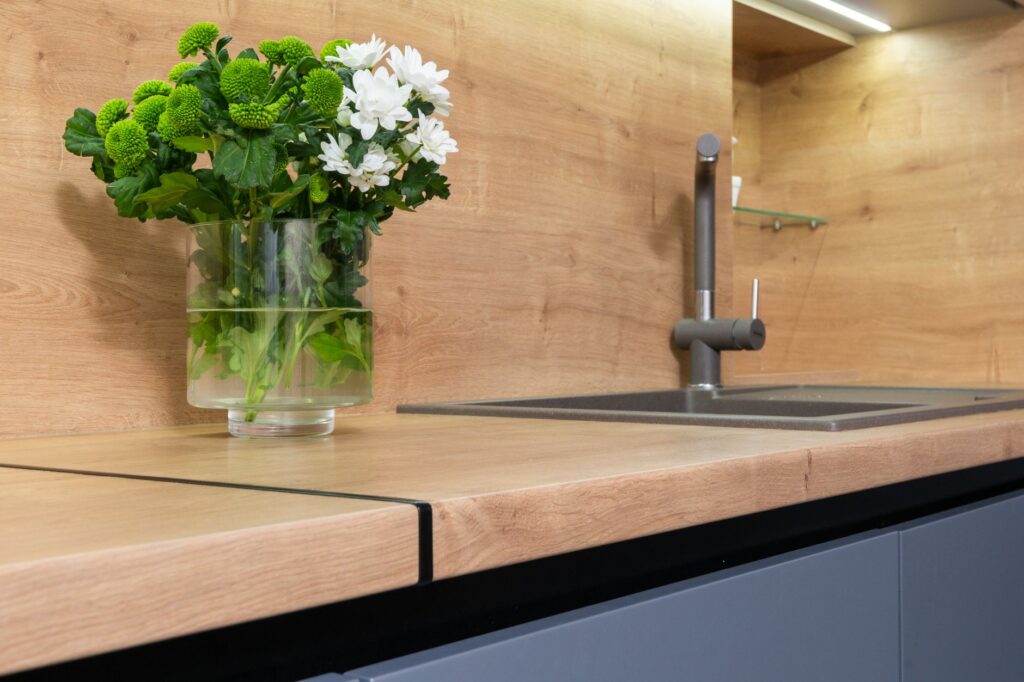
Solid wood worktops are a warm, natural choice. Makers cut hardwood planks or blocks, glue them together and finish them with oil, wax or varnish. They look warm and natural, they can be sanded and refinished, and they suit kitchens with a traditional or country feel. They also need more looking after than stone or laminate, so they suit some households better than others.
What solid wood worktops are
A solid wood worktop is made from hardwood such as oak, beech, ash, maple, iroko or walnut. Makers join strips or blocks of timber side by side, so the surface is the same wood all the way through rather than a thin veneer over board. Many people call this style of construction butcher block. Wikipedia’s entry on butcher block notes that hard maple was the traditional choice and that there are two basic styles, end grain and edge grain.
Edge-grain tops show the long lines of the wood. End-grain tops show the cut ends of the fibres and are often chosen for chopping areas. Suppliers offer both in a range of thicknesses, and a thicker top can be sanded and refinished more times over its life.
Looks and finishes
Wood gives a warm colour that changes slowly as it ages. Oak and ash show strong grain, walnut is darker, and maple is pale with a fine grain.
The finish matters as much as the species. The most common options are:
- Oil, which soaks into the wood and leaves a matt, natural look. It is easy to top up but needs regular reapplication.
- Varnish or lacquer, which forms a film on the surface. It resists water better than oil but can chip, and repairs are harder to blend in.
- Wax, which gives a soft sheen. It is usually applied over oil and needs renewing often.
Durability: heat, scratches, stains and water
Solid wood is more forgiving than stone in some ways and less forgiving in others. You can sand out knocks and scratches, so the surface can be restored rather than replaced.
Heat. Hot pans can scorch wood and dull oiled finishes. Use trivets and mats near the hob, and do not put hot dishes or kettles straight onto the surface.
Scratches. Wood marks easily from knives and heavy pots, so cutting boards help. You can sand and re-oil light marks. Deep damage usually needs a joiner.
Stains. Wine, oil and some foods soak in if they are left. Wipe up spills quickly, because dark stains can be hard to remove completely.
Water. This is the main concern. Standing water, especially around the sink, taps and dishwasher, can swell the wood, raise the grain or leave dark marks. Keep the joins around the sink properly sealed, and keep the area dry.
Hygiene and everyday care
Wood stays clean with regular washing in warm soapy water, followed by thorough drying. Avoid soaking it, and never leave a wet cloth lying on the surface. Use a food-safe mineral oil or a worktop oil made for wood, and follow the maker’s instructions on how often to reapply.
It is hard to say whether wood is more hygienic than other materials. What matters most is that the surface stays dry, is cleaned after use and has no deep cracks where food can collect.
Fitting, weight and support
Solid wood is heavy, so the base units must be able to carry it. Long runs and overhangs need extra support. Wood also moves slightly as humidity changes, so a good installer will allow for that movement rather than fixing the top rigidly.
Fitting is usually done by a joiner or a kitchen fitter with experience of timber. A good fitter seals cut-outs for sinks and hobs before use. Ask the installer how they will support the top and seal the edges, and whether the wood comes pre-finished or will need oiling on site.
Likely cost
Compared with laminate, solid wood is usually the more expensive option. Prices vary a great deal with the species of wood, the thickness, the length you need, the finish and the supplier, so this article does not give fixed figures. Ask for itemised quotes that cover the top, cutting, fitting, sink cut-outs and finishing. You can compare these with the ranges in our guide to kitchen worktop costs in the UK.
Pros and cons
- Pros: a warm, natural look, a surface that can be sanded and refinished, and a style that suits traditional and country kitchens.
- Cons: it needs regular oiling, it is sensitive to standing water and heat, it is heavy, it marks easily, and it usually costs more than laminate.
Who solid wood suits
Solid wood worktops suit people who like a natural material, do not mind some wear that adds character, and are willing to oil the surface on a regular schedule. It works well in traditional and country kitchens, and around a butler sink or a dedicated chopping area.
It is less suited to busy households where spills are frequent and not always wiped at once. A sink on a long run with little room to dry is another reason to consider something else. If you want a surface that needs almost no upkeep, look at quartz worktops or granite worktops. If your budget is tight, laminate is a common low-cost alternative.